| Leaders | Jackie Email84a; Piers Email84b |
| Day & Time | Tuesday Monthly - 3rd week 14.00 to 16.00 Doors Open 13:30 |
| Dates | Oct 21: Nov 25: Dec 16: Feb 17: Mar 17: Apr 21 |
| Venue | Shalford Village Hall (Main Hall) |
| Status | Active, open to new members |
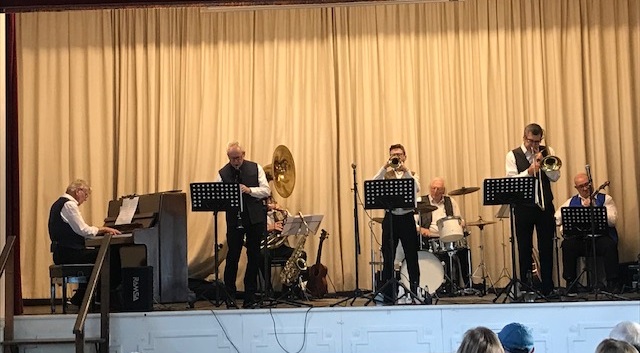


October 21st - Mike Piggott's Hot Club Quartet
November 25th - Louisiana Rhythm Kings
December 16th - Martin Litton's All Stars
February 17th - The Forest Hill Owls
March 17th - Richard Pite's Hot Quaretet
April 21st - Richard White's Nevada Street Four
Our first concert of the year for the ‘Hot Club of Shalford’ (as Mike referred to us) got off to a flying start in October as Mike Piggott’s Hot Club Quartet played their own style of gypsy jazz, with a range swing, blues and classics as inspired by the Hot Club de France. The band was made up of Mike Piggott (violin), Nils Solberg and Jarrod Elks (vocals and guitars), and Jerome Davies (on a double-bass he had made himself - a master craftsman as well as a master musician). The programme included pieces from the repertoire of Django Reinhardt and Stéphane Grappelli, as well as Duke Ellington and Charlie Parker among others.
Numbers were in a variety of styles starting with Honeysuckle Rose, followed by Nils, a reincarnation of Jerry Mengo as he sang You Came to Me Out of Nowhere in the style of Antonio Carrillo. There were foot-tapping numbers including I Love Paris in the Springtime with a segue into Bye Bye Blackbird – as well as slower ones such as the lovely French ballad Nuages and My Melancholy Baby. We even had some bossa nova from Dorado Schmidt, and the romantic Dancing Cheek to Cheek. Mike told us the background to the music numbers, as well as some amusing anecdotes about the partnership between the illiterate gypsy Django who lived in a caravan and sophisticated Stéphane and their first meeting with impresario Lew Grade. He also demonstrated his Stroh violin and explained how it was used during big band recordings onto cylinders – and demonstrated by playing it as a banjo. The concert finished with the lively Straighten Up and Fly Right and Sweet Georgia Brown.
In November we were entertained by one of the largest bands who have played for us, the seven-piece Louisiana Rhythm Kings. The band was led by Simon Wyld (trombone), with Roger Sills (sousaphone, bass, ukulele), Quentin Bryar (clarinet), Graham Collicott (drums), Tich Walker (cornet, vocals – and whistling!), Kevin Scott (banjo, guitar, vocals) and Keith Durston (piano).
They played a wide range of music mainly from 1920s and 30s with the sounds of New Orleans, Dixieland, blues and ragtime, from Duke Ellington, Louis Armstrong, Bix Beiderbecke, and the Hot Five amongst others. They started the set with the foot-tapping Dusky Stevedore, followed by Jeep’s Blues, and a change of style for Armstrong’s Oriental Strut (featuring the cornet).They played standards including Basin Street Blues (with Tich on vocals), Piron’s Bouncing Around, Jelly Roll Morton’s Pontchartrain (named after a local lake which has a bridge of nearly 24 miles, at one time the longest in the world – that’s further than the distance between Dover and Calais), and in a variety of various styles such as the Ella Fitzgerald number It’s Only a Paper Moon as a lovely bossa nova. They broke the rules and played a couple of ‘modern’ numbers – including Hello Dolly from 1963 (with Kevin on vocals).
A regular band at our concerts, Martin Litton’s All Stars played a wide range of jazz and swing standards and classics from the 20s and 30s at our December meeting, some we knew and some we didn’t. Band members were Martin Litton (piano), Michael McQuaid (clarinet, saxophone), Enrico Tomasso (trumpet, trombone, vocals) and Martin Wheatley (banjo, guitar, vocals). Enrico is now the proud owner of Vic Dickenson’s trombone, and had brought it along today. Martin gave us the background to many pieces as well as telling us stories about the different band members he had met and played with, and those who the band were emulating.
They started the afternoon off with the classic foot-tapping New Orleans rag Alexander’s Ragtime Band, followed by an unusual number, Fats Waller's, I Wish I Were Twins. Martin introduced Rube Blooom’s slow and smooth number Don’t Worry ‘Bout Me saying that ‘romance had come to Shalford’. Rube was known for writing novelty piano pieces as well as standards. They then cheered things up with China Town, My China Town, and Duke Ellington’s Drop Me Off In Harlem and Black Beauty, a number he’d written and dedicated to Florence Mills who he’d sung with at the Cotton Club and who’d died the previous year. The programme included James P. Johnson’s Old Fashioned Love, the fast tempo Al Johnson’s California, Here I Come, and the jazz standard Margie, featuring Enrico. One of the many highlights of the concert was Martin Litton’s solo version of two wonderful Gershwin melodies from 1924, Rhapsody in Blue combined with Fascinating Rhythm – based on the style of Liberace. Two numbers in completely different styles followed as Martin Wheatley sang the classic Bing Crosby number I’m an Old Cow Hand, and Johnny Dodds’ Lonesome Blues. The final number was the fast-paced Running Wild ending a great afternoon.
We enjoyed a return visit from the excellent The Forest Hill Owls in February, playing a selection of music from the 20s and 30s. These ranged in style across blues, ballads, Dixieland and stomp. Band members were Chris Lowe (leader, trombone, vocals), Michael McQuaid (clarinet, alto sax), David Horniblow (reeds, bass saxophone), Harry Evans (trumpet, cornet), Kevin Wheatley (banjo, guitar) and Dom Sales (drums).
They opened with the Farewell Blues, a perfect number to start with! then the slow number My Gal Sal. A few pieces by one of their favourite bands, Miff Mole and his Molers were played, including the foot-tapping Lucky Little Devil, a distinctive sound. The tempo slowed down with the dance number Nightfall, followed by a lively arrangement of The Swing, with Harry on cornet, and The Little Ramblers’ Cross Words Between my Sweetie and Me featuring Michael on vocals, and Tiny Parham’s Nervous Tension featuring Dom on brushes. The set also included the very appropriate number Rain with Chris on vocals, followed by a slow Duke Ellington’s Saturday Night Function, Josephine the Meanest Girl in Town, and the standard Riverboat Shuffle written by Hoagy Carmichael and recorded by Bix Biederbeck, featuring Harry on cornet and Michael on clarinet. As the programme drew to a close they played the fast-paced ragtime banjo piece Ross’ Dog Trot featuring Martin, originally performed by Eddie Ross, a minstrel player, and a bluesy section which included the Navy Blues with Chris on vocals, and Wang Wang Blues, and finished with another favourite Miff Mole number.
We were given another first-class concert and a real treat in March from Richard Pite’s Rio Trio (aka Rico Trio for the afternoon) – made up of Richard Pite (percussion, sousaphone, bass ukulele, often played at the same time - against doctor’s orders!), Enrico Tomasso (cornet, vocals) and Kevin Wheatley (banjo, guitar, vocals). They played a mix of tunes and styles from white and black jazz, including Louis Armstrong, Bix Biederbecke and Hoagy Carmichael numbers. Enrico introduced many of the pieces with amusing anecdotes – we learnt that the word ‘ukulele’ is Hawaiin for 'jumping flea', and that the expression 'the sound of surprise’ was used by Whitney Balliett to define what Jazz is. He explained the difference between a trumpet and a cornet – the conical shape of its bore gives the cornet a sound which is mellower and warmer than the trumpet.
They started with the well-known signature tune from Billy Cotton (Wakey, Wakey!) followed by My Honey’s Loving Arms first recorded by Bing Crosby, with vocals from Enrico. They played a Louis Armstrong number Save It, Pretty Mama in memory of Keith Nichols as it was one of his favourites to sing. Enrico has played cornet many times while Keith sang, but for this performance he took the vocals. He explained how he was inspired to take up the cornet when he was struggling to learn to play Basin Street Blues on the piano at the age of four – he heard Louis Armstrong play it on the cornet and knew that was the instrument for him instead. Martin played the instrumental number which became the standard Riverboat Shuffle, the waltz Jeannine I Dream of Lilac Time, an Eddie Lang solo. Also included were Stardust, at two different tempos, Willie the Weeper which was recorded by many musicians including Chris Barber, also Bix Beiderbeck and Fats Waller’s I’m Coming Virginia (a solo part which Enrico learnt at 8 years old), and Cornet Chop Suey from Louis Armstrong (‘a front line blower’). The most modern piece was The Brotherhood of Man song from the 1960s film How to Succeed in Business, and written by Frank Loesser (who also wrote Guys and Dolls). Enrico explained how jazz was invented and grew in New Orleans, and used in all celebrations – especially in the streets as part of a funeral procession, with the music played slowly and in a minor key as a dirge on the way in to the funeral, and loud and vibrant as a celebration of someone’s life on the way out. The ‘first line’ following the coffin was the official band - but anyone could join in with the ‘second line’ – and everyone did! A musician we’ve not had before (that I can remember) was Bunny Barrigan, and his I Can’t Get Started With You was played, This is one of the great orchestral jazz pieces - Bunny had a 15-piece orchestra behind him, but the Rio Trio did well! As we approached the end of the concert, Kevin played the non-jazz number, Eric Coates’ Dambusters March on the ukulele and then sang Baby Won’t You Please Come Home. They finished the afternoon with the lively Swing That Music, with Enrico on vocals.
Our final concert of the season in April proved to be very eventful. Thanks to South Western Railway the Richard White’s Nevada Street Four had to start the concert off as a Three – so Richard stepped in very proficiently as pianist with an unrehearsed opener From Me To You until Martin arrived. The complete band then consisted of Richard White (bass sax, clarinet, vocals and temp piano), Martin Wheatley (guitar, banjo, vocals), Martin Litton (piano) and Malcolm Earle-Smith (trombone, vocals).
Other numbers included I’ve Got a Feeling I’m Falling, with Richard on vocals, and I Can’t Believe That You Love Me, famously recorded by Billie Holiday and Ella Fitzgerald, and Tin Roof Blues, from Louis Armstrong. As they were playing the faster number My Blue Heaven, Richard’s clarinet split and even when the end dropped off he still kept playing! Luckily he had brought a spare with him, made of ebonite which he said he wouldn’t have that problem with. They continued with Running Wild from James P Johnson who had also composed the Charleston, then Up A Lazy River with Richard, Martin W and Malcom on vocals with just piano and strumming guitar for backing. There were a number of novelty items, including the close harmony jolly Somebody Loves Me, and the tempo slowed down with ‘the peak of perfection’ Duke Ellington’s classic Mood Indigo, and I’ve Got That Old Feeling (in C) with Richard on vocals. The afternoon finished with the foot-tapping swing number Four or Five Times.
We’ve enjoyed a great season of Jazz concerts and we look forward to seeing members again in the autumn.